Child’s progress: why the coach and parents are crucial in 3 points
The well-being of each swimmer is of paramount importance to the parent as well as the coach. Parents expect coaches to lead the way in creating a strong relationship between them and their children. This is the key to a child’s swimming progress.
1. Because the coach encourages your child to surpass himself to progress
A swimmer’s progress is much greater from age 6 to 12 than at any other time in their development.
Children progress at different rates through their physical and emotional development. Many may reach plateau phases, when improvement seems slow, but at other times they progress rapidly. The coach must always be objective and have a positive attitude to report on the child’s progress but also on the points that need to be improved.
2. Because parents must have confidence in the coach’s pedagogy and the child’s abilities…
This is where the role of the parent becomes crucial. In addition to reassuring the child, he or she should encourage and support the child. Believe in him, while leaving the necessary space for the coach. In fact, your child may have a difficult start
because he is afraid of water
. But this fear will gradually diminish if the child is in a serene environment, where everyone acts positively for the child. Since the parent’s fear can be contagious to the child, it should not be passed on to the child or the coach. Because fear can cause mainly stress, anxiety and anger. And it is the whole course that can be impacted. Give the keys to the truck to the coach who is
trained in the Swim Stars pedagogy
and knows the kids very well.
3. … without overestimating the child’s progress
Indeed, the temptation for the parent is to register the swimmer on slots still out of reach compared to his real level. This is especially true if the child has early physical development. But it may also be due to a misperception of the parent. Generally after a return from summer vacation, progress can be overestimated because it is not properly analyzed. The coach, whose job it is, must be listened to by the parent so that the swimmer can flourish in the most appropriate group. Indeed, if the level is too high, your child will not want to come and learn to swim. Because swimming is likely to be a physical suffering first, then a moral suffering. This is counterproductive!
To avoid such mishaps, we give more explanations and advice on
the transition of levels between our different swimming courses
. In order not to miss any steps and to progress safely,
here is our program and our evaluation tests.
Swim Stars coaches always in the water with students: why and for what pedagogy?
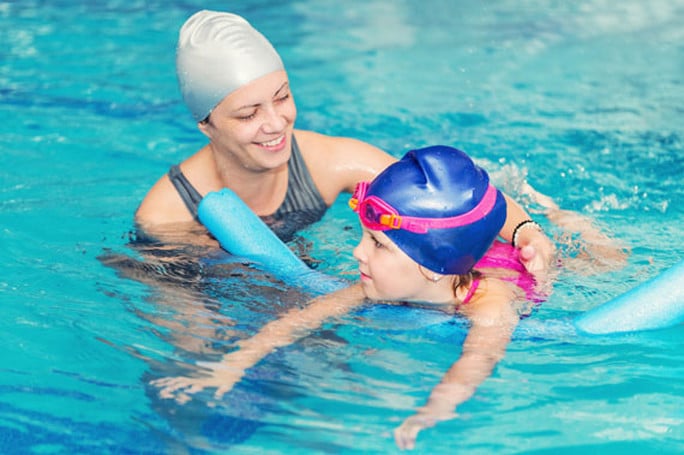
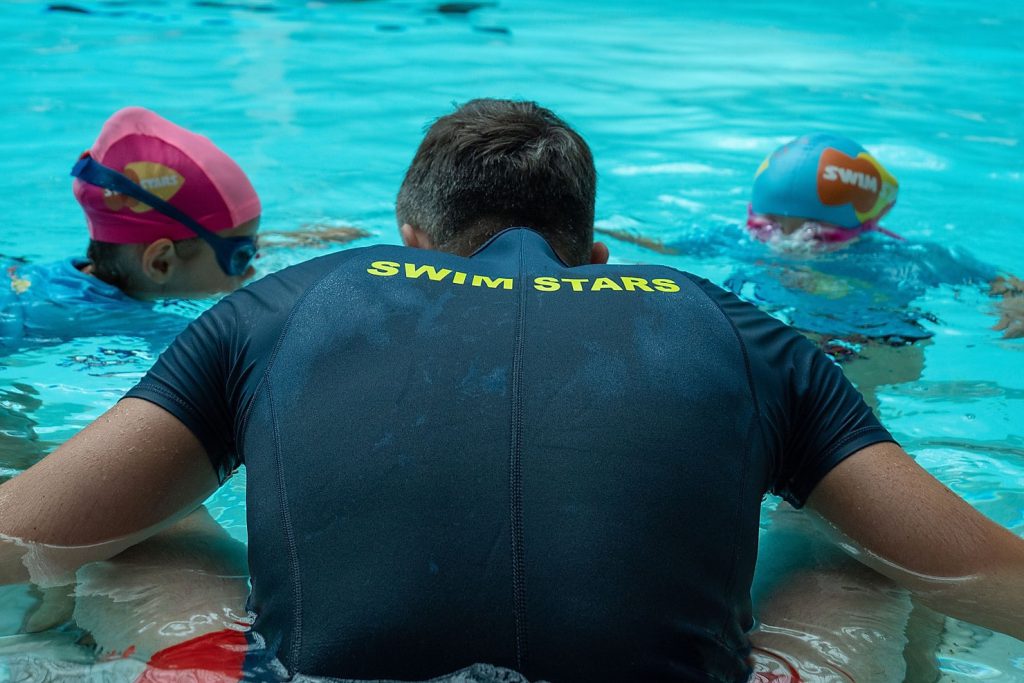
Our Swim Stars coaches are always in the water with the students for a better pedagogy. The small group classes allow the coaches to conduct a dynamic session. Because the coach in the water challenges the students throughout the course. Thus, by alternating group and individual exercises, the coach allows everyone to progress.
The coach in the water for more proximity
The AUTO-RESCUE® in-water coach to keep toddlers safe
For the SELF-RESCUE® classes (self-rescue skills from age 3), it is essential to ensure the safety of our little swimmers. But above all, to create a relationship of proximity and trust. Because this is often an age when mom and dad are very important to the child. Why? Because they convey better than anyone else the sense of security that a child needs. The coach’s goal is to reassure the little ones that no one is in danger of swallowing the cup!
It is also the first time that a small fish usually joins other small fishes unknown to the group. What’s more, with a man or woman wearing a diving suit, who is none other than the coach. It is finally as stressful as the first day of school. Indeed, we are far from imagining how scared a child can be, especially if the pool is very big! For this reason, there are
several pools of different sizes within our
within our learning network.
For a great start, the immersion of small fish is done gradually, especially with the help of stairs. Indeed, the configuration of many pools, like hotels, allows to enter the water gently step by step. When it’s a pool with a ladder, like in gyms, we also adapt the water entrance so that they can hook the edge. The depth is average and generally the same throughout the pool, but we also have a regressive depth in some of our pools.
However, the principle is the same. First, we immerse the small feet, then the legs. Then, we sit these buttocks if we are on steps and we begin the bubbles, then we wet the face. We go for the ring to soak more and we work the starfish to be safe. Then, we take off with the frit in support to learn how to move. Finally, for the most daring, we jump into the water with or without frit to join his coach in the arms.
In the water learning to build confidence
The beginning of the first grade is often a fundamental step in the child’s development. In fact, it regularly coincides with the beginning of swimming lessons in school. For many, this prospect is indeed an anguish. Especially for parents who are not reassured to let their fearful child start this activity. While municipal swim clubs may refuse admission to children who do not meet the age and skill requirements after an assessment test, Swim Stars accepts all children. This is the case from the age of 5 in the learning course (or less for children who have validated theAUTO-RESCUE®).
The same caring and reassuring approach as for toddlers is favored because fear with age can be amplified. Thus, for beginners in learning, the basics ofAUTO-RESCUE® are regularly evaluated because there is a pedagogical continuity between the two programs. Indeed, the difference lies essentially in the maturity, concentration, understanding of the instructions and the physical capacities of the child in terms of coordination. It is essential to start learning the backstroke, the crawl and the breaststroke.
Therefore, it is essential for Swim Stars that a 5 year old child, even a beginner, can evolve with children of the same age in learning and not in SELF-RESCUE® . This is essential for the child’s confidence and much more rewarding than being with toddlers. Even if it is difficult at first, the small group allows the child to watch others do it, motivates him more than anything else, and allows him to imitate his buddies. After all, why not me? In only one month, progress is very fast.
Out of the water in improvement to correct the technique
It’s time for the big swim and the long distances! Indeed, it is time to swim for several lengths and with intensity. Now that the children have gained independence, the coach can get out of the water. Security and trust have been validated and it is now the requirement that will prevail. In the course of improvement, it is therefore sometimes useful to give instructions from the outside for a better analysis of the swimming technique. This is also true for turns or initiation to diving: position of the arms with the head tucked in and starting position for impulse. For certain technical exercises, at the discretion of the coach, the latter can enter the water to accompany the movements and improve them.
What about adults? In the water as an adult aquaphobe to support psychologically
For example, in adult aquaphobia courses, whose objective is to fight against aquaphobia, the reassuring presence of the coach in the water near the students is a real
psychological support
.
Beginners and advanced adult perf players are then naturally much more autonomous and independent.
In general for Swim Stars, having the coach in the water is an asset in order to give the student confidence , to listen to him and to accompany him. And never forget to have fun and enjoy yourself!
https://blog.swimstars.fr/pedagogie-coach-swim-stars-portrait-emilie/
Why does having a coach to teach my children to swim make all the difference?
Learning to swim requires fun, effort and consistency. To give your children the necessary motivation and every chance to succeed, we believe that the accompaniment of a Swim Stars coach represents 3 main advantages
The 3 advantages of hiring a coach for my child
1. A coach to give you every chance to succeed
Swim Stars coaches will supervise your children during the swimming lesson. Our team is trained in the same pedagogical content and shares common objectives. The goal is to give your child every opportunity to learn to swim. We prefer small groups to involve all the children, with the coach in the water. By being present during the swim lesson, the parent can also observe our approach and use it as inspiration to adopt the right attitude.
However, being a coach is a job and the natural authority he or she has is necessary to pass on knowledge to your child. In the same way that you can’t become a school teacher, you can’t replace the coach. She is the only person he will listen to. Your role as a parent is to encourage and play with your child in the water so that swimming becomes a pleasure!
2. To listen and give confidence
The Swim Stars coaches have an essential quality which is listening. It is thanks to our benevolence and at the same time our requirement that we manage to retain our members. We want to get to know you better andaccompany your children in their life journey. To do this, we focus on the good atmosphere of the group to motivate the children, give them the smile and confidence they need to unleash their potential.
“You should always listen to the child if he is well with the coach”.
This is the pedagogical advice given by Emilie, Swim Stars coach, during an interview for the blog.
3. To have a pedagogical follow-up
Having a coach who knows your child well because he trains him every week is the key to progress. Indeed, thanks to the regularity and the pedagogical follow-up, your child will have an exponential progression curve. Then, when your little fish has reached a certain level of comfort and confidence, it may be worthwhile to change coaches.
Indeed, change can be beneficial because it can bring a fresh perspective to make you progress even faster. It is also a way to get the child out of his comfort zone. Because a new coach may have new requirements!